Palestine as a Divine Trust: The Collective Responsibility of the Ummah
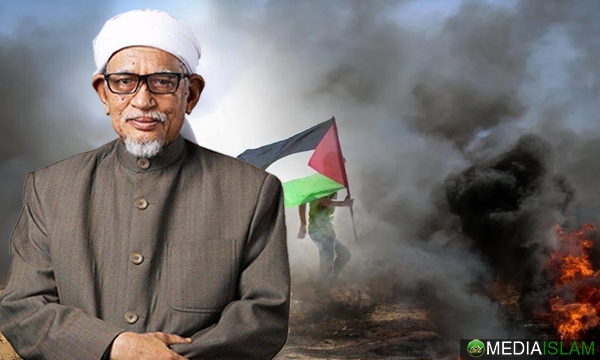
Tuan Guru Abdul Hadi Awang begins by emphasizing that Palestine is a trust (amanah) from Allah to the entire Muslim Ummah.
This trust is not merely historical or political, it encompasses dimensions of faith (‘aqidah) and divine responsibility.
He connects this message with the words of Allah in Surah an-Nisā’, verse 75:
وَمَا لَكُمْ لَا تُقَـٰتِلُونَ فِى سَبِيلِ ٱللَّهِ وَٱلْمُسْتَضْعَفِينَ مِنَ ٱلرِّجَالِ وَٱلنِّسَآءِ وَٱلْوِلْدَٰنِ
“And what is [the matter] with you that you do not fight in the cause of Allah and for those oppressed among men, women, and children who say, ‘Our Lord, take us out of this city of oppressive people…’” (Surah an-Nisā’, 4:75)
This verse demonstrates that defending the oppressed, including the Palestinian people, is a direct command from Allah, not merely a moral choice or a matter of political sympathy.
Thus, defending Palestine is a demand of faith, a form of jihad that must be fulfilled according to one’s ability, whether through strength, wealth, knowledge, writing, or prayer.
The Holy Land and the Legacy of the Prophets
Tuan Guru stresses that the land of Palestine is not merely a geographical territory but a sacred land blessed by Allah, as mentioned in many Qur’anic verses:
سُبْحَـٰنَ ٱلَّذِىٓ أَسْرَىٰ بِعَبْدِهِۦ لَيْلًۭا مِّنَ ٱلْمَسْجِدِ ٱلْحَرَامِ إِلَى ٱلْمَسْجِدِ ٱلْأَقْصَا ٱلَّذِى بَـٰرَكْنَا حَوْلَهُۥ
“Glory be to Him who took His servant by night from the Sacred Mosque to the Farthest Mosque whose surroundings We have blessed.” (Surah al-Isrā’, 17:1)
Al-Masjid al-Aqsa is the first qiblah of Muslims and the site of the Isra’ and Mi‘raj of Prophet Muhammad ﷺ.
It is also the land that holds the legacy of prophets, Abraham (Ibrahim), Isaac (Ishaq), Jacob (Ya‘qub), David (Dawud), Solomon (Sulaiman), Zechariah (Zakariya), and Jesus (‘Isa), peace be upon them all.
Hence, when this sacred land is occupied and defiled by Zionists, who not only seize its territory but also attempt to erase its Islamic identity and historical truth, it becomes not only a political issue but an affront to the dignity of Islam and a betrayal of the prophetic heritage.
To defend Palestine is therefore to protect faith, dignity, and the sacred legacy entrusted by Allah since ancient times.
A Nation That Abandons Revelation Will Be Humiliated
He then reminds us that the fall of Palestine is not solely due to external aggression but largely due to the internal weakness of the Muslim Ummah itself.
History teaches that the Children of Israel were once honoured because of their obedience to divine revelation.
Still, when they turned away from Allah’s law, they were humiliated and lost their power.
That same pattern now repeats within the Muslim world.
When Muslims abandon the divine system, they become divided and weak, while their enemies exploit that disunity.
وَلَا تَهِنُوا۟ وَلَا تَحْزَنُوا۟ وَأَنتُمُ ٱلْأَعْلَوْنَ إِن كُنتُم مُّؤْمِنِينَ
“Do not weaken and do not grieve, for you will be superior if you are [true] believers.” (Surah Āli ‘Imrān, 3:139)
Tuan Guru reminds us that true honour (‘izzah) will only return when Muslims fully return to Islam, not merely in name or symbolism, but in every system of life: politics, economics, education, and society.
The Courage of Gaza: Faith That Cannot Be Defeated
He highlights the bravery and steadfastness of Muslims in Gaza as the living manifestation of true faith.
Though they lack weapons and live under siege from land, sea, and air, their faith remains unshaken.
For them, martyrdom (shahādah) is not a loss, but a divine honour:
وَلَا تَحْسَبَنَّ ٱلَّذِينَ قُتِلُوا۟ فِى سَبِيلِ ٱللَّهِ أَمْوَٰتًۢا ۚ بَلْ أَحْيَآءٌ عِندَ رَبِّهِمْ يُرْزَقُونَ
“Do not think of those who have been killed in the way of Allah as dead. They are alive, receiving provision from their Lord.” (Surah Āli ‘Imrān, 3:169)
This is the reality of spiritual victory, a victory the modern world cannot comprehend, for it measures strength by military or economic means alone.
Gaza stands as a symbol of living faith, proving that the real strength of Muslims lies in their belief and patience (sabr).
The Danger of Pluralism and the “Abrahamic” Faith Concept
One of the most important warnings from Tuan Guru’s speech is about the danger of religious pluralism and the concept of the “Abrahamic Faith,” which seeks to equate all religions as equal paths to God.
He firmly states that Islam cannot be equated with other faiths, as its truth is absolute and final:
إِنَّ ٱلدِّينَ عِندَ ٱللَّهِ ٱلْإِسْلَـٰمُ ۗ
“Indeed, the religion in the sight of Allah is Islam.” (Surah Āli ‘Imrān, 3:19)
Movements that attempt to merge Islam, Christianity, and Judaism in the name of “peace” and “tolerance” in fact blur the boundaries of creed and weaken the unity of Muslims.
He stresses that the honour of the Ummah lies in the purity of its creed (‘aqidah) and in unity under the banner of Islam, not in compromising principles under the illusion of interfaith unity.
Unity of the Ummah and Collective Responsibility
Tuan Guru concludes his address with a call for unity of hearts and collective action among Muslims, reminding the words of the Prophet ﷺ:
مَثَلُ الْمُؤْمِنِينَ فِي تَوَادِّهِمْ وَتَرَاحُمِهِمْ وَتَعَاطُفِهِمْ كَمَثَلِ الْجَسَدِ، إِذَا اشْتَكَى مِنْهُ عُضْوٌ، تَدَاعَى لَهُ سَائِرُ الْجَسَدِ بِالسَّهَرِ وَالْحُمَّى
“The example of the believers in their affection, mercy, and compassion for each other is like that of a single body; when one part of it suffers, the whole body responds with sleeplessness and fever.” (Reported by al-Bukhari and Muslim)
Palestine is a limb of the body of the Ummah.
When it is hurt, the entire body must feel its pain through prayer, charity, awareness, and struggle.
He emphasizes that jihad today is not only on the battlefield, but also in the fields of knowledge, media, and public consciousness.
The Ummah must awaken from negligence, enlighten the world, and unite to uphold the dignity of Islam.
Conclusion: Palestine as a Reflection of the Ummah’s Faith
This address carries a profound message that Palestine mirrors the faith and unity of the Muslim Ummah.
When Palestine is betrayed, it reflects the Ummah’s weakness; when it is defended sincerely, it signals the rise of Islam.
Tuan Guru Abdul Hadi Awang’s speech is not merely a political or humanitarian appeal, but a manifesto of faith and jihad, calling every Muslim to view Palestine not as a distant issue, but as a Divine Trust (Amanah) demanding action, prayer, and loyalty to the religion of Islam.
About the Author