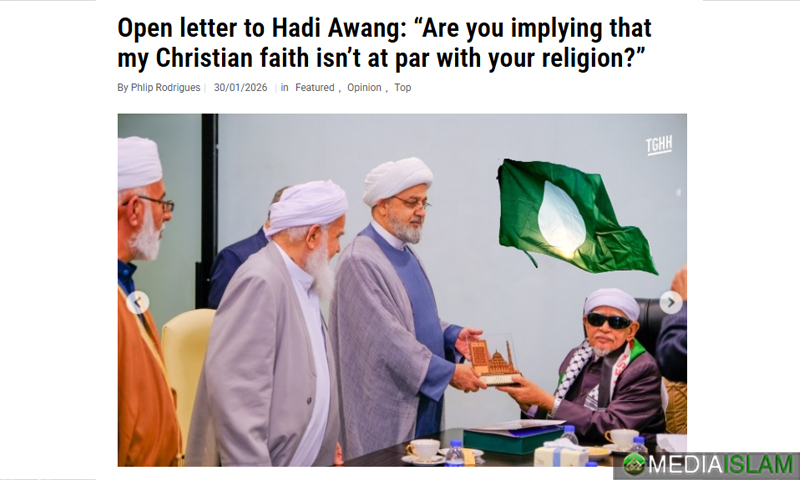
The article by Phlip Rodrigues titled ‘Open Letter to Hadi Awang: Are you implying that my Christian faith isn’t at par with your religion?’ is not merely an open letter.
Rather, it reflects a fundamental confusion regarding the concept of Islam, the history of civilisation, the meaning of moral leadership and the framework of religious life within a plural society.
More troubling is that this confusion is then translated into accusations that Tuan Guru Haji Abdul Hadi Awang is religiously arrogant, demeaning towards followers of other faiths, and allegedly threatening harmony in Malaysia’s multi-ethnic and multi-religious society.
In reality, these accusations arise from a misunderstanding of Islam as ad-din, a comprehensive way of life, rather than merely a “private religion”.
1. Islam “Above” Other Religions: A Matter of Faith, Not Insult
Phlip Rodrigues takes offence at the statement that Islam must be above all other religions to save humanity, interpreting it as an insult to Christianity and other faiths.
This interpretation is theologically and philosophically flawed.
In Islam, the belief that Islam is the final and ultimate truth is a core tenet of faith (aqidah), not a political statement nor an attack on other religions.
The Qur’an clearly states:
هُوَ ٱلَّذِىٓ أَرْسَلَ رَسُولَهُۥ بِٱلْهُدَىٰ وَدِينِ ٱلْحَقِّ لِيُظْهِرَهُۥ عَلَى ٱلدِّينِ كُلِّهِۦ
“It is He who has sent His Messenger with guidance and the religion of truth to make it prevail over all religions.” (Surah at-Tawbah: 33)
This is an internal statement of Islamic belief, just as Christianity holds that salvation is only through Jesus Christ, or Judaism upholds the concept of the “chosen people”.
Such beliefs have never meant coercion, oppression, or humiliation of others.
Islam itself affirms:
لَآ إِكْرَاهَ فِى ٱلدِّينِ
“There is no compulsion in religion.” (Surah al-Baqarah: 256)
Therefore, claims that Tuan Guru intends non-Muslims to “bow down” or submit are narrative fabrications, not the substance of his statements.
2. Islam Is Not Merely a Moral Religion, but a Complete Way of Life
Phlip argues that all religions are equal and that all teach moral goodness.
While this may be comforting within a liberal framework, it is inaccurate from a scholarly religious perspective.
Islam not only teaches personal morality; it provides:
- A value system
- A framework of justice
- Economic principles
- Ethical governance
- Concepts of international relations
When Tuan Guru speaks about saving humanity, he is referring to a global crisis caused by the failure of secular and materialistic systems, not calling for a religious war.
The reality of today’s world demonstrates that:
- Endless wars
- Economic oppression
- Family breakdown
- Human exploitation
occur not because religion is too dominant, but because religion has been removed from the management of human life.
3. The “Malay World” and the Misreading of History
Phlip also questions references to the Malay World, as if Tuan Guru is attempting to rewrite history and elevate the Malays as the centre of global civilisation.
This is another misunderstanding.
Tuan Guru’s remarks refer to demographic reality and potential, not claims of absolute supremacy.
Today, the Malay World:
- Possesses a large Muslim population
- Is relatively stable compared to the Middle East
- Has space for da‘wah and moral leadership
This does not deny the historical contributions of Arabs, Persians, or Andalusia.
Rather, it affirms a historical responsibility: any community endowed with strength bears an obligation to contribute positively to humanity.
4. Allegations of Violence and Taking Up Arms: Fantasy or Slander?
Among the most baseless accusations is the portrayal of Tuan Guru as allegedly calling Muslims to rise as “warriors” and take up arms against the world.
This directly contradicts the consistent stance of PAS and Tuan Guru himself, who has repeatedly emphasised:
- Peaceful approaches
- Struggle through democratic means
- Rejection of violence against civilians
Linking calls for Muslim unity with violence is a well-worn tactic of Islamophobia, not an honest analysis.
5. Malaysia, PAS, and the Reality of Governance
Phlip accuses PAS of being:
- Anti-democratic
- Oppressive towards non-Muslims
- A failure in governing Kelantan
Yet the facts show:
- PAS operates fully within the electoral and parliamentary system
- Non-Muslims live and practise their faith freely in Kelantan
- Kelantan’s poverty issues are closely tied to federal economic structures and historical marginalisation
Recycling old stereotypes without data is political rhetoric, not a scholarly argument.
6. “Save Malaysia First”: A False Dichotomy
Finally, Phlip concludes with the slogan “Save Malaysia first”, implying that advocating Islam and contributing to global humanity contradict national interests.
In Islam, self-reform, societal reform, and global responsibility are not mutually exclusive; they are sequential and interconnected.
The Prophet Muhammad ﷺ built Madinah while simultaneously conveying the message to the world.
Conclusion: Differences in Faith Are Not Grounds for Misrepresentation
Tuan Guru Haji Abdul Hadi Awang has never demeaned other religions.
He speaks from the standpoint of Islamic faith, which naturally affirms Islam as the path of salvation.
Such differences should be engaged through mature dialogue, not manipulated into manufactured fear.
Malaysia does not need politics that erases religion, but politics that is ethical, principled, and just to all.
Criticism is a right, but intellectual honesty is also a moral obligation.
About the Author