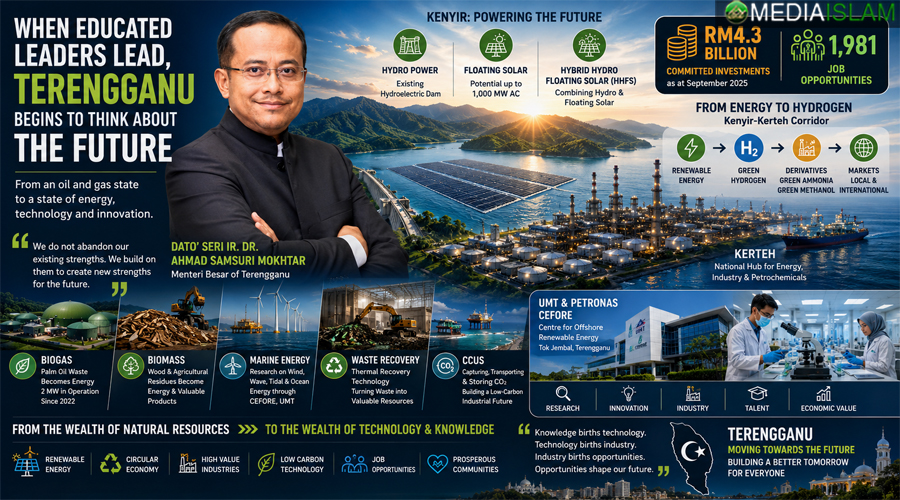
From an oil and gas state to a state of energy, technology and innovation
For decades, whenever people talked about Terengganu, one of the things most often associated with the state was oil and gas.
There is no denying that the petroleum and petrochemical industries are among the state’s major economic strengths. Kerteh, for example, has developed into one of the country’s important centres for the oil, gas and petrochemical industries.
But the world is changing.
Energy is changing. Technology is changing.
The way industries produce goods is changing.
Countries around the world are racing to build new economies based on renewable energy, hydrogen, energy storage technologies, the circular economy, artificial intelligence and low-carbon industries.
Amid this major transformation, Terengganu is also moving forward.
Interestingly, this transformation does not mean abandoning the strengths the state already possesses.
Instead, Terengganu appears to be pursuing something more strategic: using its existing strengths to build new strengths.
Oil and gas are still here.
But alongside oil and gas, we are seeing solar, hydro, biogas, biomass, marine energy, green hydrogen, green ammonia, green methanol, waste recovery technologies and CCUS.
This is no longer simply the story of one project.
It is beginning to look like the formation of a new energy and technology ecosystem.
RM4.3 Billion in Committed Investments
One important indicator is the development of investment.
ECERDC reported that Terengganu recorded RM4.3 billion in committed investments as of September 2025, expected to create around 1,981 job opportunities.
More significantly, one of the major drivers of this investment is the hybrid solar project at Tasik Kenyir, valued at around RM2.9 billion.
At the same time, realised investments in Terengganu had reached RM1.6 billion.
These figures are important because they show that discussions about new energy are no longer confined to laboratories or conference halls.
Capital is already moving.
Infrastructure is being developed.
Cooperation is taking place between the state government, government-linked companies, universities and industry.
And most importantly, there are opportunities to create new employment.
Kenyir: An Old Asset Seen in a New Way
Tasik Kenyir is one of Terengganu’s greatest assets.
For years, we have viewed Kenyir as a water resource, a hydroelectric reservoir, a tourism destination and a natural treasure.
But modern technology is causing us to look at the same asset from a different perspective.
Kenyir is now becoming part of the development of Hybrid Hydro Floating Solar (HHFS).
The concept combines hydroelectric power with floating solar energy.
This is not simply about installing solar panels on water.
It is an effort to integrate two renewable energy sources within a single energy system.
TNB states that the Kenyir reservoir has the potential for up to 1,000 MW AC of floating solar capacity, although development is being carried out in phases.
The initial phase forms part of the process of assessing feasibility and expanding capacity in a structured manner.
PETRONAS has also described the Kenyir HHFS project, launched in 2025, as an important development in integrating floating solar with existing hydroelectric infrastructure.
What this means is that we are looking at something bigger than a solar project.
We are looking at a laboratory for the energy of the future.
From Kenyir to Hydrogen
More interestingly, energy development in Kenyir is not planned to stop at electricity generation.
On 12 July 2025, TNB, PETRONAS and Terengganu Inc. launched the development of the Hybrid Hydro Floating Solar and Green Hydrogen Hub in Terengganu.
PETRONAS states that the Green Hydrogen Hub is planned as an end-to-end value chain connecting renewable energy, green hydrogen production and derivatives such as green methanol and green ammonia.
This is where the development becomes much more interesting.
Energy generated from renewable sources can be used to produce hydrogen through electrolysis.
That hydrogen can then become a basic feedstock for other industries.
From energy to hydrogen.
From hydrogen to industrial products.
From industrial products to markets.
This is how a state can begin moving from selling resources to creating greater value from those resources.
Kenyir and Kerteh: Two Worlds That Can Be Connected
One of Terengganu’s unique advantages lies in the complementary roles of Kenyir and Kerteh within a single ecosystem.
Kenyir has hydroelectric resources and renewable energy potential.
Kerteh, meanwhile, has industrial, energy and petrochemical infrastructure, together with technical expertise that has been developed over decades.
PETRONAS states that the Green Hydrogen Hub in Terengganu is planned within the Kenyir-Kertih Corridor, utilising renewable energy development and grid infrastructure in Kenyir, as well as PETRONAS facilities and infrastructure in Kertih.
The value chain is also planned to include electrolyser facilities, hydrogen derivative plants and CCUS facilities in Kertih.
This represents a highly interesting development concept.
Energy resources in one area can be connected to an industrial ecosystem in another.
If successfully realised, it could create an economic value chain far greater than electricity generation alone.
The Terengganu Sea Also Has Technological Value
Terengganu has another advantage that we sometimes take for granted because it has always been part of our lives.
The sea.
The South China Sea is not merely a source of fish and a tourism destination.
It also has energy potential.
In 2025, Universiti Malaysia Terengganu, together with PETRONAS, launched the Centre for Offshore Renewable Energy (CEFORE) at Pantai Tok Jembal.
CEFORE brings together research in wind energy, solar energy, wave energy, as well as energy storage and management systems.
UMT sees the centre as a platform that combines academic expertise with industrial needs.
This is actually more important than simply having a research centre.
A state cannot become a technology state simply by buying technology from abroad.
It must have people who are capable of understanding, testing, adapting and developing that technology.
Universities Can No Longer Merely Produce Graduates
This is where the relationship between UMT and PETRONAS becomes important.
The world today needs universities that do more than teach theory.
Universities need to help industries solve real-world problems.
Researchers need to work with engineers.
Students need exposure to real technologies.
Laboratories need strong connections with industry.
And research discoveries need opportunities to be translated into products and services.
CEFORE is an example of such a model.
UMT brings academic expertise and research capabilities.
PETRONAS brings industrial experience.
Together, they can produce something much greater than either side could achieve independently.
This is the university-industry model that should be expanded throughout the country.
Biogas: Turning Palm Oil Waste into Energy
Terengganu’s green technology transformation did not begin with hydrogen.
One example that is already operating is biogas technology based on palm oil industry waste.
TDM has biogas plants at the Kemaman Palm Oil Mill and the Sungai Tong Palm Oil Mill.
POME waste, which previously had to be managed as an industrial waste product, can be used to produce biogas and subsequently generate electricity.
Both plants have been fully operational since 2022, with a combined capacity of around 2 MW.
This is a simple but very important concept: industrial waste does not necessarily have to end up as a problem.
With the right technology, it can become an economic resource.
Kemaman Waste: From Burden to Resource
Developments in Kemaman demonstrate another emerging direction.
Waste recovery technology using thermal processes is being introduced as an approach to managing waste that is difficult to recycle through conventional methods.
The objective is to recover materials with economic value from waste.
This represents a change in the way we look at rubbish.
Traditionally:
Waste is collected.
Waste is transported.
Waste is buried.
But the circular economy asks a different question: “What value is still contained within this waste?”
There may be materials that can be recovered.
There may be materials that can be processed.
There may be materials that can become new products.
This is the philosophy of waste-to-wealth.
Of course, every waste recovery technology must be carefully assessed in terms of cost, safety, regulation, and environmental impact.
Nevertheless, the basic principle is highly interesting: waste does not necessarily have to be the end of an economic value chain. It can become the beginning of a new one.
Biomass: Wealth We Have Been Throwing Away
Terengganu also has significant potential in biomass.
Wood waste, agricultural waste and industrial by-products can have value as feedstock for energy and bio-based products.
This is important because green technology development is not only about solar panels and wind turbines.
It is also about how we use resources that have previously been underutilised.
If agricultural waste can become an energy feedstock, farmers can gain new economic opportunities.
If wood waste can be processed into valuable products, industries can gain additional sources of revenue.
If industrial waste can be reused, disposal costs can be reduced.
This is the principle of the circular economy: reducing waste by increasing the value of every resource.
Kerteh and CCUS: Carbon Also Needs to Be Managed
Terengganu cannot discuss the energy of the future as though oil and gas will disappear overnight.
The oil, gas and petrochemical industries remain important.
Therefore, the more realistic question is:
“How can we reduce carbon emissions from industries that are still needed by the economy?”
This is where CCUS, Carbon Capture, Utilisation and Storage, becomes relevant.
The technology aims to capture a portion of CO₂ from industrial sources, transport it and store it in a controlled manner.
PETRONAS is also assessing the potential for offshore carbon storage in the Duyong area as part of the development of the Southern CCS Hub.
This demonstrates an important point:
Terengganu does not necessarily have to choose between existing industries and new technologies.
Both can move forward during a period of transition.
Existing industries can continue contributing to the economy, while new technologies are developed to reduce environmental impacts and create future industries.
What Is Changing Is Not Only the Energy Source
When we look at all these developments separately, they may appear to be small projects with no connection to one another.
But when viewed as a whole, the picture is different.
We have:
Hydroelectric power in Kenyir.
Floating solar in Kenyir.
Biogas from the palm oil industry.
Biomass potential.
Research into wind and wave energy through CEFORE.
Green hydrogen development.
Potential green ammonia and green methanol.
Waste recovery technologies.
And CCUS development.
Together, they point towards one major change:
Terengganu is diversifying its energy economy.
This Is What Development Based on Knowledge Means
In my view, the most interesting aspect of these developments is not the solar panels.
Not hydrogen.
Not turbines.
And not even the investment figures.
The most interesting aspect is the thinking behind the development.
Because technology does not emerge on its own.
It requires leaders who understand the importance of knowledge.
It requires officials capable of translating policy into action.
It requires universities that are willing to collaborate.
It requires companies willing to invest.
It requires engineers and researchers.
It requires skilled technical workers.
And ultimately, it requires a government capable of bringing all these parties together.
Therefore, when we talk about educated leadership, we should not understand it merely as possessing certificates or degrees.
Knowledge-based leadership is the ability to see global changes early and prepare the state to face them.
What If This Approach Were Brought to the National Level?
This is where we can ask a bigger question.
What if this way of thinking were expanded throughout Malaysia?
What if each state were identified according to its unique strengths?
Terengganu could become one of the centres for new energy and green industries.
Sarawak has enormous hydroelectric potential.
Sabah has potential in renewable energy and the maritime economy.
Penang has a strong semiconductor ecosystem.
Johor has strengths in logistics, industry and digital infrastructure.
Kedah has agriculture, industry and solar energy potential.
Perak has mineral resources, industry and energy.
Selangor has a strong digital economy, technology and services sector.
Each state could have its own technology strategy while contributing to a unified national strategy.
Malaysia would no longer compete for investment simply because of cheap land or low labour costs.
Malaysia would attract investment because it possesses: knowledge, talent, technology, infrastructure, energy, universities and industrial ecosystems.
That is the competition of the 21st-century economy.
Malaysia’s Problem Is Not a Lack of Resources
In reality, Malaysia is not poor in resources.
We have oil and gas.
We have forests.
We have agricultural land.
We have the sea.
We have abundant sunlight.
We have water.
We have universities.
We have a large workforce.
But the bigger question is:
“To what extent can we transform all these resources into technology and added value?”
A country that merely sells raw materials will receive lower value.
A country that processes raw materials will receive greater value.
A country that develops the technology to process those raw materials will receive even greater value.
And a country that controls technology, owns intellectual property, produces high-value products and controls international markets will occupy the highest position.
From “Resource Rich” to “Knowledge Rich”
Perhaps this is the biggest transformation Malaysia needs.
We cannot continue building an economy based on: “We have resources.”
We must move towards: “We know what to do with those resources.”
Terengganu has oil.
But oil can support the development of petrochemical industries.
Terengganu has water.
Water can become part of the hydrogen value chain.
Terengganu has sunlight.
Sunlight can become electricity.
Terengganu has palm oil waste.
That waste can become biogas.
Terengganu has the sea.
The sea can become a laboratory for marine energy technologies.
Terengganu has waste.
Waste can be recovered into valuable materials.
Terengganu has heavy industry.
That industry can become the foundation for CCUS and low-carbon technologies.
This is the transformation from resource wealth to technological wealth.
And This Is Where the Role of Ir. Dr. Ahmad Samsuri Becomes Interesting to Observe
Of course, all these projects cannot be regarded as the achievement of one individual.
They involve the state government, the Federal Government, PETRONAS, TNB, Terengganu Inc, ECERDC, UMT and many other parties.
But a leader plays an important role in determining the direction.
In the context of Terengganu, Dato’ Seri Ir. Dr. Ahmad Samsuri Mokhtar has an academic background in engineering and was involved in academia before entering politics.
Perhaps this is why his development approach, particularly one oriented towards technology and energy, is interesting to observe.
At East Coast Energy 2025, the agenda of clean energy, biogas, biomass, hydro, solar, wind, hydrogen, waste management, Waste-to-Energy, and CCUS was placed within the broader discussion of energy development on the East Coast.
When a leader understands that the world is moving from an old energy economy towards a more complex energy economy, he does not merely ask: “What do we have today?”
He begins to ask: “What will the world need ten or twenty years from now?”
That is the difference between merely managing a state and planning for its future.
Not Every Project Will Succeed
However, we must also be realistic.
Not every new technology will succeed commercially.
Not every planned project will achieve its original capacity.
Costs may increase.
Technology may change.
The hydrogen market may develop more slowly than expected.
The costs of solar, energy storage and electrolysers may change.
Government policies may also change.
Therefore, we should not claim that Terengganu has already become a global green energy hub.
Not yet.
Some initiatives are still at the research stage.
Some are still at the pilot stage.
Some are under development.
And some remain plans.
But the direction of travel can already be seen.
And that direction matters.
Progress Is Not Measured Only by What Has Already Been Completed
Sometimes we are too quick to judge development based on what we can see with our own eyes.
We can see completed roads.
We can see completed buildings.
We can see completed bridges.
But research is different.
Universities developing expertise are not always visible.
Laboratories testing technologies rarely become major news.
Students being trained to become the engineers of tomorrow do not look like mega-projects.
Yet all of these things ultimately determine whether a state is capable of moving forward.
Infrastructure builds physical capacity.
Knowledge builds human capacity.
And when the two are combined, technology can flourish.
Terengganu May Be Building Something Bigger Than Projects
When we look at Kenyir, Kerteh, CEFORE, the palm oil industry, waste projects, universities and investments separately, we may see only several individual projects.
But when they are placed together within a larger picture, we see a possibility:
Terengganu is building an energy ecosystem for the future.
From hydroelectric power.
To solar.
From solar to hydrogen.
From hydrogen to industrial products.
From waste to energy.
From biomass to valuable materials.
From the sea to energy research.
From carbon to CCUS.
And from universities to a highly skilled workforce.
This is what makes these developments so interesting.
If This Succeeds, What Will Change?
What changes will not simply be the number of megawatts of energy produced.
What changes will be the structure of the economy.
The children of Terengganu may no longer seek employment only in traditional sectors.
They could become hydrogen engineers, solar energy specialists, energy storage engineers, marine energy researchers, CCUS specialists, electrolyser technicians, automation specialists, energy data analysts, environmental specialists, circular economy experts, green technology entrepreneurs and professionals in many new occupations that may not even exist today.
This is the real value of technology.
It is not merely about machines.
Technology creates new jobs.
When Educated Leaders Lead
Perhaps we need to look at politics from a slightly different perspective.
We are too accustomed to judging leaders based on their ability to deliver speeches.
We assess who is good at debating.
We assess who can criticise their opponents effectively.
But the world we are entering requires something greater.
We need leaders who can understand technology, understand economics, understand global changes, understand energy, understand education, understand industry and, most importantly, connect all of these with the interests of the people.
A leader does not need to be an expert in every field.
But he must know which experts need to be brought to the discussion table.
He must know the right questions to ask.
And he must have the courage to plan for outcomes that may only become visible five, ten, or even twenty years later.
That is forward-looking leadership.
Imagine If This Approach Became a National Culture
Imagine if Malaysia adopted the same approach.
Every state would have its own technology strategy.
Every university would have strong links with industry.
Every ministry would have clear innovation targets.
Every research project would have a pathway towards commercialisation.
Every industry would cooperate with educational institutions.
Every young person would be trained for the jobs of the future.
And every state would compete not merely to build buildings, but also to build human and technological capabilities.
Malaysia might no longer merely be a country that adopts technology.
We could become a country that develops technology.
We could become a country that tests technology.
We could become a country that exports technology.
And ultimately, we could become a country with a high-value, knowledge-based economy.
From Resource Wealth to Technological Wealth
Terengganu has a long history as a state rich in natural resources.
But the new generation requires a different definition of wealth.
Wealth is no longer simply about how much oil lies beneath the ground.
Wealth is about how much value we can create from knowledge.
It is not merely about how much gas we extract.
It is about how many high-value products we can produce from it.
It is not merely about how much sunlight we receive.
It is about how much energy we can generate from it.
It is not merely about how much water we possess.
It is about how effectively we can use it within the energy value chain of the future.
It is not merely about how much waste we produce.
It is about how much material we can recover from it.
And it is not merely about how many graduates we produce.
It is about how many are capable of creating technology and solving problems.
Terengganu Is Moving Forward
It may be too early to say that Terengganu has already become a green technology state.
But it is not too early to say that Terengganu is moving in that direction.
The journey may not be perfect.
Some projects are still at the pilot stage.
Some are still being studied.
Some are under development.
Some require greater investment.
And some will only prove their success several years from now.
But every great journey begins with a first step.
From oil and gas towards a more diversified energy mix.
From waste to biogas.
From sunlight to energy.
From Kenyir to floating solar.
From renewable energy to hydrogen.
From hydrogen to green ammonia and methanol.
From the sea to marine energy research.
From waste to material recovery.
From carbon-intensive industries towards CCUS and low-carbon technologies.
And from universities to industry.
This is the transformation taking place in Terengganu.
And perhaps this is also a larger lesson for Malaysia.
We are not short of resources.
We are not short of educated people.
We are not short of universities.
We are not short of engineers.
We are not short of opportunities.
What we need is leadership capable of connecting all of them.
Because when knowledge meets leadership, technology can flourish.
When technology meets industry, the economy can grow.
When the economy grows in the right way, jobs are created.
And when all of this ultimately benefits the people, development acquires its true meaning.
From the wealth of natural resources to the wealth of technology.
Perhaps that is the future being built.
And perhaps, if this approach based on knowledge, technology and long-term planning were expanded to the national level, Malaysia could move beyond being merely a consumer of technology.
We could become a nation that creates technology.
Insya-Allah.
About the Author